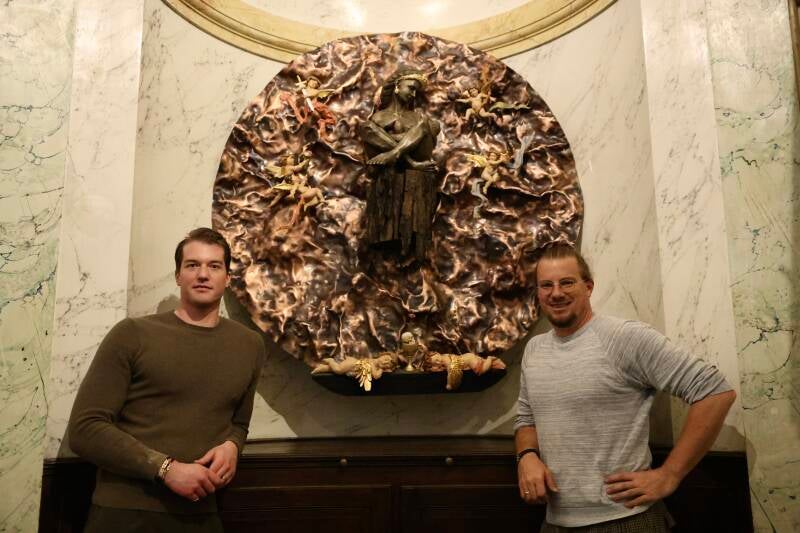
"Mutterliebe" Sint Jacobskerk by Joachim Sietfudem
Joachim Seitfudem
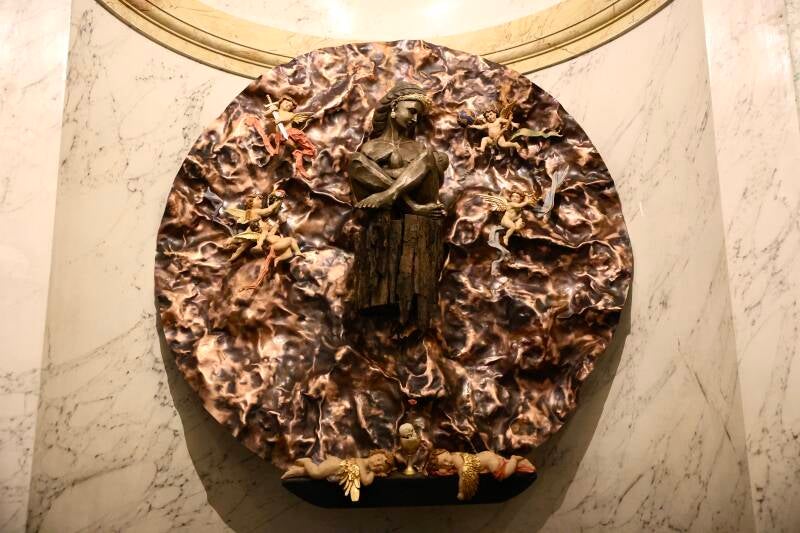
The Madonna itself is first carved from wood and will later be cast in bronze. This process preserves the unique marks and textures of the original wooden sculpture in the bronze.
What is also very special is that this is the first time I have used my wife as a model. We have been together for almost 20 years, and I had never before made a drawing or sculpture of her, so this was a wonderful opportunity. It was also meaningful to create a small sculpture of my child.
The Madonna wears only a golden crown and golden earrings. This symbolizes that every mother is a queen, while the earrings represent her dignity, wealth, and status.
I chose to depict her nude to show the beauty of every mother and to remind us that we all enter this world the same way: naked and free.
She is seated upon a 10,000-year-old oak trunk, symbolizing the ancient origins of modern humanity.
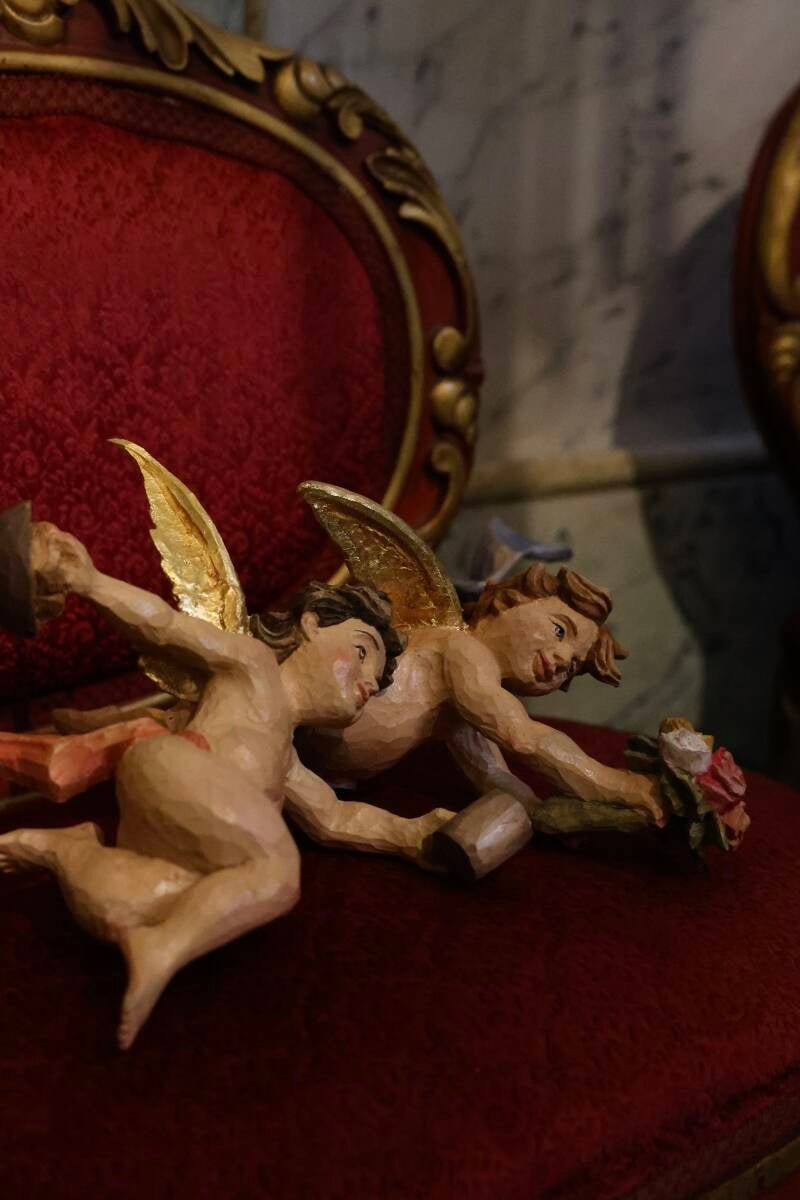
The Madonna and Child are surrounded by five angels, carved from linden wood. Each angel carries an attribute intended for the newborn child.
One angel bears a sword to ward off evil and wickedness and to symbolize the strength needed to defend oneself. This angel is sculpted more robustly as a representation of power and resilience.
Another angel holds a globe, symbolizing that the world lies in the hands of humankind — not to exploit or dominate, but to respect, cherish, and care for as God’s paradise. This angel appears wise and educated, and its garment gradually transforms into a wooden branch.
The third angel carries a crown, representing that every child is both prince and princess, deserving of kindness, respect, and love, and encouraged to share these values with the world. The child should also learn responsibility and wisdom. Therefore, this angel has a regal appearance.
The fourth angel offers beautiful flowers as a symbol of beauty, for every child is beautiful. Accordingly, this angel is given an especially graceful face and hairstyle.
The fifth angel brings a basket of food and a jug of milk or beer, symbolizing abundance and the hope that no one should ever suffer hunger or thirst. This angel is therefore fuller in the belly and face, joyfully celebrating these gifts.
These are the five angels who bring heavenly gifts. At the very bottom lie two additional angels, asleep beside a chalice containing a skull and a rose. This is the chalice of life, symbolizing that one day we will awaken again and return to eternal life. We do not truly die, but merely enter a deep sleep.
The angels, the Madonna, and the bog oak are mounted upon a hammered copper plate, creating the impression that the figures are floating in heaven.
This artwork brings together all the techniques and materials that define my artistic practice: wood, bronze, and metal.
Interview between the artist and the collection manager
Antwerp’s Sint-Jacobskerk carries a long and powerful artistic history shaped by the Flemish masters. What did it mean for you to place a new work in dialogue with that tradition, and how did the architecture and atmosphere of the baptism chapel influence your design process?
“It meant entering a space with a strong historical and artistic presence. I did not try to imitate that tradition, but rather to respond to it honestly through my own visual language. The influence was more indirect, emerging from the atmosphere and history of the space itself. The baptism chapel felt quiet, intimate, and concentrated, and this strongly guided the work.
The verticality and proportions of the chapel led me toward a composition that feels elevated and centered. The light within the space reinforced the idea of making the sculpture appear lighter, almost floating. That is why the hammered copper plate became so important: it visually detaches the sculpture from the ground and gives it an almost heavenly quality.
The work is also intended to be experienced from different angles as the viewer moves through the chapel.”
Your work is installed in a living church rather than a museum. How did the religious context of the baptism chapel shape the meaning of the sculpture?
“The work is about birth, motherhood, and the beginning of life, but also about the complete cycle of human existence. It was not created for a neutral space, but for a place where people actively live their faith. That made the work more direct and accessible.
During a baptism ceremony, I hope the sculpture evokes a sense of dignity, protection, and meaning. I hope that parents and loved ones feel that every child is welcomed with value, beauty, and responsibility.”
You chose to portray your own wife and child in Mutterliebe. What did that personal decision mean for the work?
“It was very important because it was the first time I used my wife as a model. We have been together for almost twenty years, and I had never before made a drawing or sculpture of her. This felt like the right moment.
The same is true for my child. Because of that, the work is no longer anonymous; it is directly connected to my own life.”
Could you elaborate on how this image reimagines the tradition of Marian imagery?
“The Madonna was first carved in wood and later cast in bronze. As a result, the bronze surface still carries the unique traces of the wood carving.
The Madonna is nude except for a golden crown and golden earrings. I wanted to show the natural beauty and dignity of every mother and remind us that we all enter this world naked and free.
The crown symbolizes that every mother is a queen, while the earrings refer to status. She sits upon a large piece of 10,000-year-old oak, symbolizing the ancient nature of humanity and connecting the work to a much broader sense of time and existence.”
You mention that this work unites all your techniques. The sculpture integrates wood, bronze, and hammered copper. How do these materials “speak” to one another conceptually?
“I am interested in the combination of the softness and immediacy of carving with the permanence of bronze. The hand of the maker remains visible within a material that suggests eternity.
This work also brings together all the materials and techniques I use in my practice. Wood contains warmth and life, bronze provides permanence, and copper connects the sculpture to light and space.
The angels, the Madonna, and the oak wood are all mounted on the hammered copper plate, which enhances the sensation of floating. This artwork unites all the techniques and materials I use in my art: wood, bronze, and metal.
Bringing all these elements together into one coherent work without losing clarity was one of the greatest challenges of the project. Mutterliebe feels like a culmination of my artistic practice.”
The five angels surrounding the Madonna and Child each carry symbolic gifts. Could you explain their meanings, as well as the sleeping angels at the base of the sculpture?
“Each angel has a specific meaning, but together they form a complete constellation. They are carved from linden wood, and each brings an attribute for the newborn child.
One angel carries a sword to defend against evil and wickedness and to symbolize strength; this is why the figure is built more robustly.
Another holds a globe to show that the world lies in human hands — not to exploit, but to respect and care for as God’s paradise. This angel appears more intellectual, and the drapery transforms into a wooden branch.
A third angel carries a crown to symbolize that every child is a prince or princess deserving kindness, wisdom, respect, and responsibility. This angel therefore has a more regal appearance.
The fourth angel brings flowers as a symbol of beauty, because every child is beautiful. This is reflected in the angel’s graceful face and hairstyle.
The fifth angel carries food and drink — milk or beer — as a symbol that no one should suffer from hunger. This angel therefore appears fuller and more joyful.
At the very bottom lie two sleeping angels beside a chalice containing a skull and a rose. This introduces mortality into the work. The chalice represents the chalice of life, while the sleeping angels symbolize that we do not truly die, but rest before awakening again into eternal life.
Birth and death belong together; they are both part of the same cycle.”
Your work contains symbolism, yet still feels open to interpretation. Were there aspects you intentionally left unresolved for the viewer?
“Yes. The symbolism is present, but it is not closed. I wanted to leave space for the viewer to complete the work through their own experiences and interpretations.”
Artist: Joachim Seitfudem
Collection Manager: Rutger van der Steenhoven
Philip Baron Heylen
Ereschepen Stad Antwerpen |
Honorary Vice Mayor City of Antwerp |
In the baptismal chapel of the restored St. James’s Church in Antwerp, the space where P.P. Rubens once had his children baptized, stands the moving work ‘Mutterliebe’ by the German artist Joachim Seitfudem. The artwork radiates a warm combination of hope, security, love, and faith, in harmony with the meaningful context.
Seitfudem uses a variety of materials — wood, bronze, and metal — which together form a harmonious whole and highlight his versatility as an artist. The work also contains rich symbolism: the depiction of mother and child, reminiscent of a classical Madonna, is surrounded by angels and refers to protection and innocence . This visual language closely connects to the meaning of baptism and faith, where care, connection, and new life are central. When you not only look at the work but truly ‘feel’ it, it becomes immediately clear that the artist has woven a part of his own emotions into it.
The choice of this artist, combined with the historical and spiritual setting, creates a remarkable symbiosis in which art, history, emotion, and faith reinforce one another.
Thomas Gielen, Thomas Gallery
What can I say… there simply are not enough words to describe what this means to me. The fact that my gallery — and especially my artist Joachim — was given the opportunity to realize this commission by the board of Saint James’ Church is an incredible honour.
“Commissioned” is perhaps one of the most beautiful words in the art world. It is the very word connected to all the great masters throughout history, creating works for institutions, churches, and places filled with meaning. The board of Saint James’ Church chose us for this project
and for that I am deeply grateful.
Together, we were able to create a modern Madonna, fully designed and tailored to the existing bay window of the church. Joachim and I gave everything we had to bring this work to life. And of course, here in Antwerp — our beautiful baroque city — it is impossible to ignore the spirit of the great masters. Nor would we ever want to.
But at the same time, we wanted to speak in a contemporary language. A Madonna for today. About openness. About freedom. About the beauty and tenderness of motherhood. About the beauty of being a child in this existence.
Grateful. Proud. And above all, deeply moved that we were able to create this together.